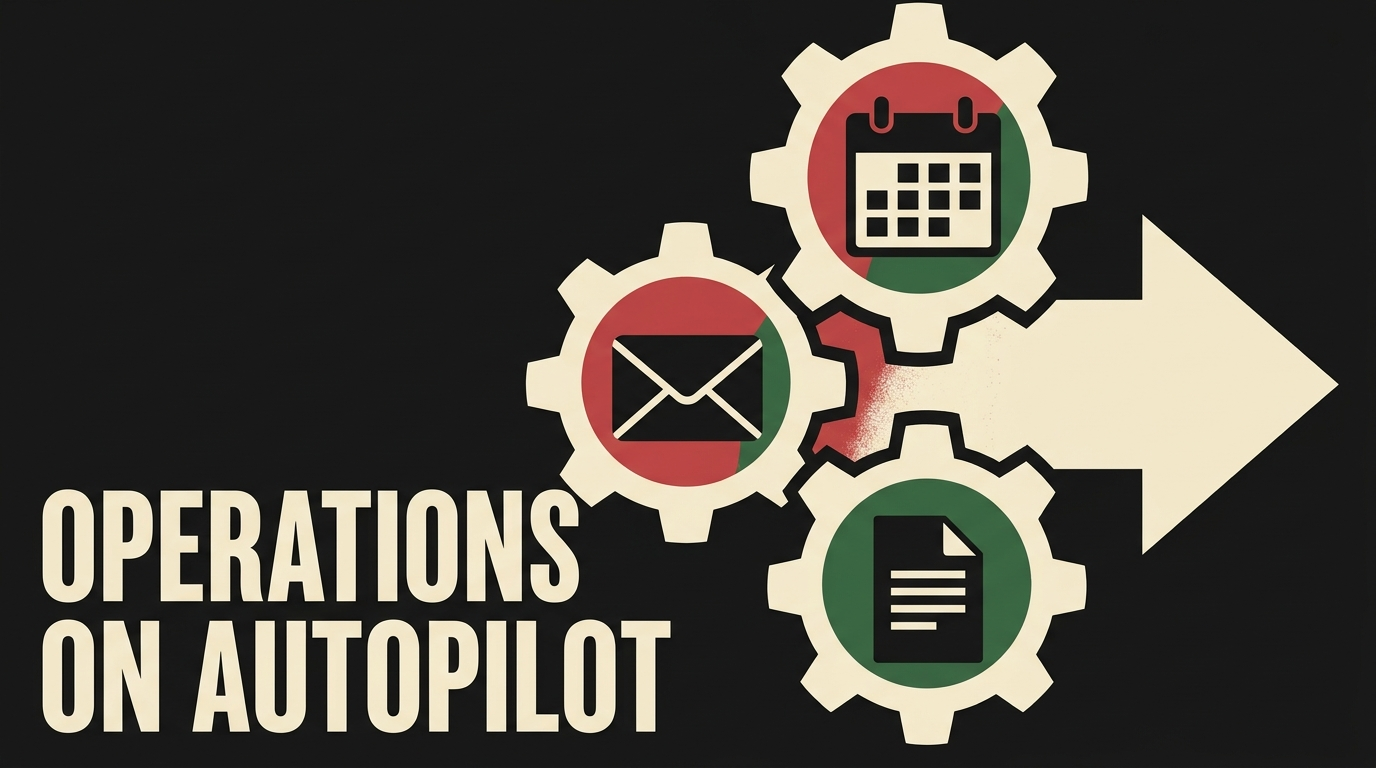
Here's what eats most business owners' time: not the big decisions. Not the meetings. It's the invisible admin tax that runs in the background every single day.
You finish a client call — now you need to write the notes, assign the follow-ups, and send a summary. A prospect books a meeting — you need to send them prep materials and add it to your calendar. An invoice is due — you need to remind the client, track if they paid, and log it. None of this is strategic. All of it is necessary. All of it interrupts your actual work.
The math is brutal: a typical business owner spends 15–20 hours every week on this stuff. That's half your workweek doing things a system should be doing for you.
The Real Cost of Manual Admin
You can't just ignore these tasks. Client notes that don't happen create confusion and lost details. Invoices that don't get followed up turn into uncollected payments. Calendar conflicts eat meeting time.
But here's the problem that nobody talks about: each one of these tasks also breaks your concentration. You're in the middle of real work — responding to a client proposal, planning next quarter — and then you switch context. You need to send a meeting reminder. Or log a payment. Or write those notes from yesterday's call.
Research on attention switching shows it costs you about 15 minutes just to get back to full focus. Not 15 seconds. Fifteen minutes. So every time you interrupt yourself to handle admin, you're not just losing the five minutes it takes to send the email. You're losing the recovery time.
This is the hidden cost nobody measures. You're working 50 hours a week and actually thinking hard for maybe 25 of them.
How Rundara Handles It Without You
Rundara is an AI operations agent — think of it as an assistant that runs 24/7 and only works on the patterns you define. You're not programming anything. You're describing workflows in plain English.
Here's how it works in practice:
- You describe a workflow once. Not in code. In English. "When a client books a call with me, send them a pre-call document and add the meeting to my calendar." Or "After I finish a meeting, extract the action items and send them to the client within an hour."
- Rundara learns the pattern and asks clarifying questions if it needs them. Where's your calendar? Where do you store prep documents? What tone should the reminder email use? Once it has those details, it's configured.
- It runs automatically. Every time that situation happens — a client books, a meeting ends, an invoice approaches the due date — Rundara does the thing. No notification. No approval step.
The result: your calendar syncs itself, your notes write themselves, your follow-ups happen without you remembering, and your invoices get tracked.
What to Do This Week
Start with one workflow. Not all of them at once. Pick the single admin task that interrupts you most often — probably calendar management, meeting notes, or invoice follow-up.
Describe it to Rundara. Show it where your calendar lives, where your emails go, what done looks like. Let it run for a week. If it works, add another one. If it doesn't, adjust the description and try again.
Most business owners who try this find they've gotten back a full day a week within two weeks. That's time you can spend on the work that actually matters — the calls you want to take, the strategy work you've been putting off, the people you want to hire.