I've been producing video professionally since before most of my current clients were born. Network television. Documentary. Corporate. Fortune 500 brand campaigns. Live events. I've shot in conditions ranging from a controlled studio in Burbank to a dust storm in the Sahara. I know what this industry looks like from the inside.
So when I tell you AI is changing production, I'm not doing it from a press release or a LinkedIn think piece. I'm telling you from the edit bay, from the pre-production room, from the conversation with the DP where we used to spend three hours planning a shot list and now we spend forty-five minutes.
Let me be direct about what's actually shifting — and what isn't.
The Part That's Actually Changing: Pre-Production
This is where AI earns its keep. Pre-production has always been the unsexy part of the job — the script breakdowns, the location research, the mood board assembly, the budget line-item juggling. It's the work that happens before anything exciting starts, and it used to eat a disproportionate share of your timeline and your margins.
Now? I can drop a creative brief into a session and have a full shot list drafted in minutes. Not a perfect shot list — I still rewrite it with my DP. But it's a real starting point, not a blank page. I can run a script breakdown automatically, flag continuity issues before we ever get to set, and stress-test a production schedule against weather data and permit windows.
That's not replacing my judgment. That's giving me more hours to actually use it.
Scripting and Concept Development
Here's something most producers won't admit: the first draft is almost always bad. Doesn't matter how experienced the writer. The first draft is about getting the ideas out of your head and onto something you can react to.
AI has collapsed the cost of that first draft to near zero. I can generate three different structural approaches to a brand narrative in the time it used to take to schedule a kickoff call. The client sees more options. We move faster to the version that actually works.
What doesn't change: you still need to know a good story when you see one. The senior creative director's eye isn't going anywhere. What AI removes is the time tax on ideation — the grinding hours of getting conceptual options onto paper before the real creative conversation can even start.
On Set: Mostly Unchanged (By Design)
And honestly? Good. The on-set experience is where the actual craft lives. Lighting is physics. Performance is human. The relationship between a director and a subject — that's built in real time, in a room, and no algorithm touches it.
Where AI has made inroads is in monitoring and technical optimization. Smart cameras with AI-assisted focus and exposure. Real-time color grading previews. On-set continuity analysis that flags costume or prop inconsistencies between takes. These are workflow accelerants, not creative substitutes.
The director still calls action. The DP still makes the picture. The producer still reads the room.
Post-Production: The Most Dramatic Shift
This is where the volume of change is hardest to overstate.
Assembly cuts that used to take days now take hours. AI-assisted transcription and rough cut assembly from a script means your editor walks in with a starting point instead of 200GB of raw footage and a shot list. Automated color matching across a long-form project. De-noising audio that used to require expensive studio time. Music licensing that matches your edit's emotional arc.
The assembly cut is not the edit. The rough cut is not the story. The tools that shortcut the mechanical work are genuinely valuable — but they do not shortcut the creative judgment about what the piece needs to become.
What AI Does Not Change
It doesn't change story instincts. It doesn't change the political intelligence of managing a client relationship. It doesn't change the ability to earn a subject's trust in a documentary interview. It doesn't change the taste required to know when a take is magic versus technically correct.
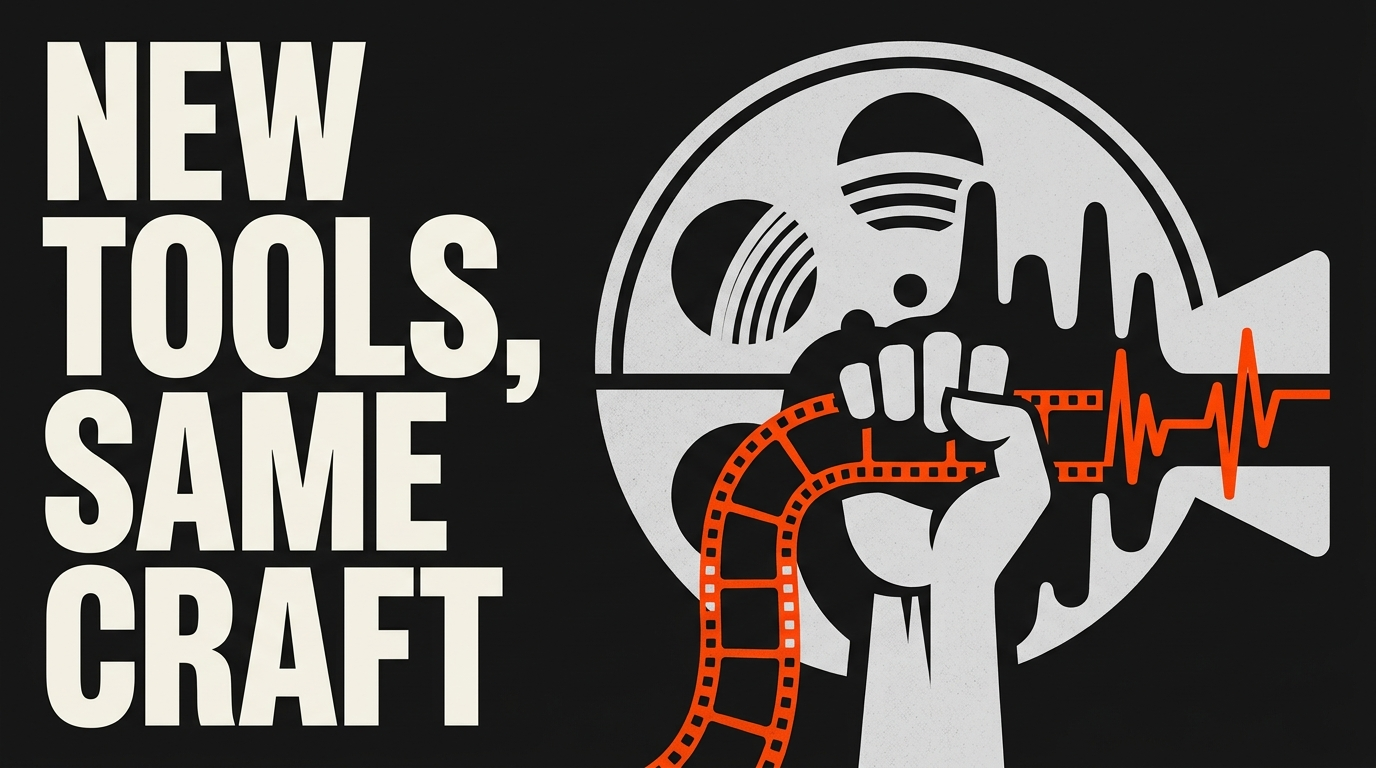
Production is a human business. Always has been. The tools change. The machinery changes. I went from film to video to digital to 4K to AI-assisted workflows over the course of a career, and each transition felt seismic while it was happening and obvious in retrospect.
This one is no different.
The Real Competitive Advantage
The competitive advantage isn't in using AI. Everyone's using AI now or will be within eighteen months. The advantage is in knowing enough about production craft to know where AI helps and where it makes things worse.
There are production companies right now using AI-generated storyboards with no understanding of whether the shots are cinematically coherent. There are agencies using AI scripts without producers who know how to recognize when a story structure doesn't work.
Experience matters more now, not less — because you need enough judgment to know when the machine got it right.
Where I've Landed
After 35 years in this industry, I'm more energized now than I've been at any point in the last decade. Not because AI is magic. Because AI is a serious tool that lets me spend my time on the parts of this work that only I can do.
The logistics, the drafts, the administrative overhead — the machine handles a bigger share of that now. The storytelling, the creative direction, the client relationships, the final call on what the piece becomes — that's still mine.
And honestly? That's the deal I always wanted.